Network and IT for warehouses and transport that hold up through every shift.
Handheld scanners, gate cameras and links between sites all run on a network that was built for offices – and in a warehouse, that shows first. NDVDL plans and builds network, Wi-Fi and video surveillance for freight forwarders, warehouse operators and cross-docks in Vienna, Lower Austria and Slovakia.
- A direct line to your engineer
- Operation including hardware replacement
- Planned and built for your business
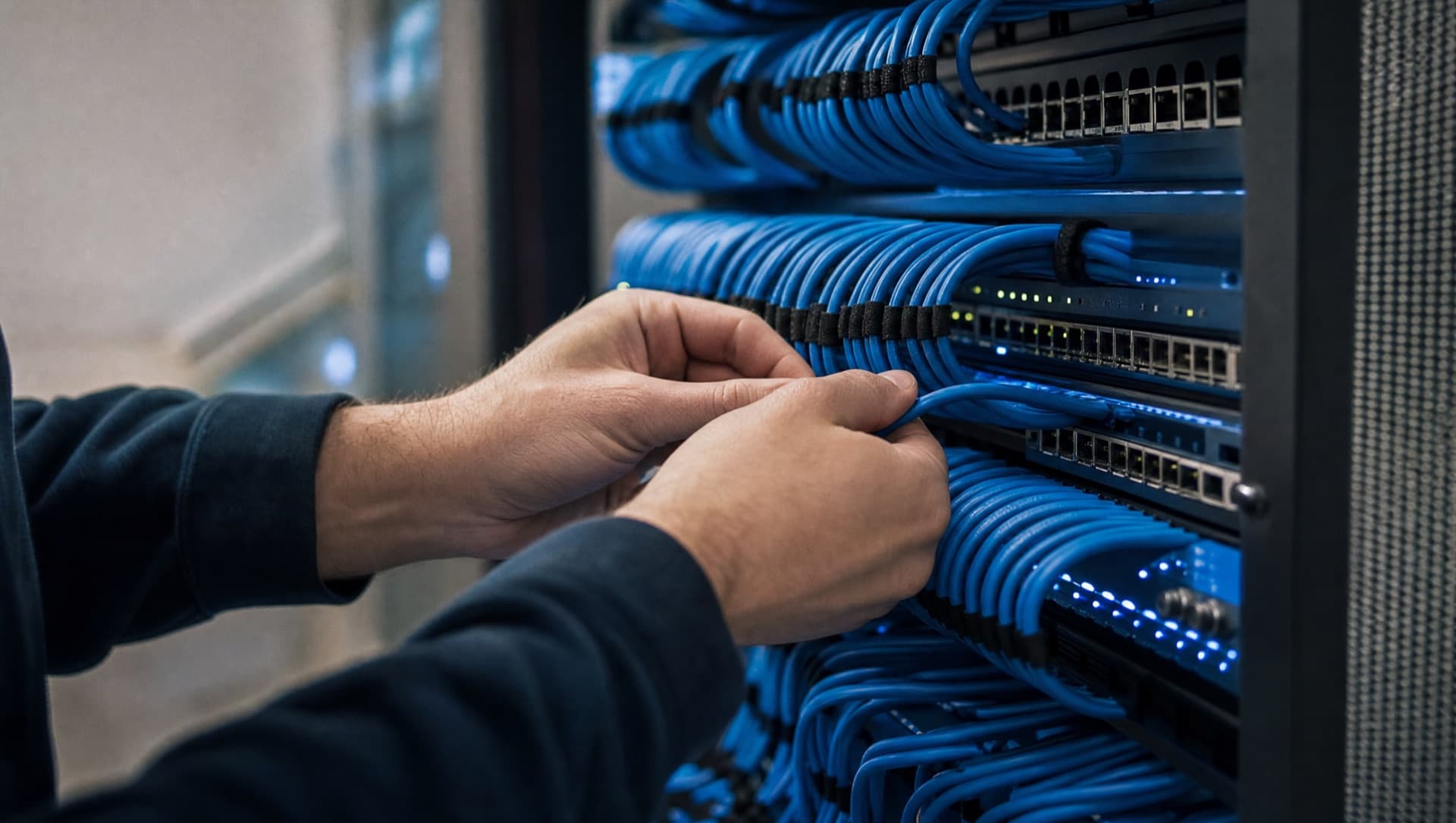
Why doesn't standard office Wi-Fi work in a high-bay warehouse?
Standard office Wi-Fi usually falls short in a high-bay warehouse. Steel racking and long aisles reflect or absorb the signal, so handheld scanners and MDE devices lose connection at the edges of aisles or stall when handing off between access points. NDVDL plans the Wi-Fi layout around the actual racking and aisle structure and configures roaming so scanners stay connected as they move between access points. The same applies to chillers and unheated areas, where standard equipment takes extra strain from cold and condensation.
What actually goes wrong in warehouses and freight operations
Not theory – the failure patterns that show up in high-bay racking, chillers and the yard.
Dead spots between racking aisles
Handheld scanners drop connection mid-aisle because steel racking reflects or blocks the Wi-Fi signal. Staff have to log back in or repeat scans, which interrupts picking.
Drops when switching between access points
MDE devices stall when handing off from one access point to the next because roaming isn't configured cleanly. This shows up most in long aisles and across multiple racking rows.
Network equipment can't take cold and condensation
Switches and access points built for office temperatures fail or run unreliably in chillers and unheated warehouse sections. A failure there often takes out an entire picking zone.
Sites and cross-docks drift apart
Without a stable link between the warehouse, a branch and a cross-dock, stock data in the warehouse management system and TMS falls out of sync. That often only shows up once a delivery isn't where the system says it is.
IT infrastructure for warehouses, cross-docks and fleets
Six building blocks that can be implemented individually or together, matched to racking, ramps and shift work.
Wi-Fi coverage for high-bay warehouses
Access point placement is planned around the actual racking and aisle layout, not a generic template. Roaming is configured so handheld scanners and MDE devices stay connected as they move between access points.
Network for chillers and unheated areas
Chiller and freezer zones get hardware rated for cold and condensation instead of repurposed office equipment. The network is set up as its own segment so a failure there doesn't take down the whole warehouse.
Site and cross-dock connectivity
Warehouses, branches and cross-docks in Austria and Slovakia are connected via VPN or SD-WAN. That keeps warehouse management and TMS working from the same stock and order data, regardless of location.
Video surveillance for gates, ramps and the yard
Camera systems cover gate areas, loading ramps and the yard, including number-plate capture for entry. Setup accounts for drivers and third-party personnel on site and is aligned with GDPR requirements for video surveillance.
Connecting warehouse management and TMS
Existing warehouse management and transport management systems are connected to customer systems through interfaces and EDI. Existing systems stay in use rather than being replaced wholesale.
IT support, backup and contingency planning for shift work
Ongoing support is built for operations that run shifts around the clock. Backup and a contingency plan mean a network or server failure doesn't stop the whole warehouse.
Related services in detail
For your region in detail
What warehouse and freight projects tend to look like
Three project shapes that come up regularly in practice.
New warehouse or expansion with an MDE rollout
A warehouse operator brings a new hall online or expands an existing one and wants handheld scanners working throughout. NDVDL plans the Wi-Fi coverage around the racking layout, places access points accordingly and configures roaming for the MDE devices.
Chiller zone gets its own network segment
A warehouse with a chilled or frozen zone needs network equipment that actually holds up there instead of improvised office hardware. NDVDL sets up a dedicated segment built for the conditions and adds backup for the connected systems.
Multiple sites need to work together
A freight forwarder with sites in Austria and Slovakia wants to manage warehouse management, TMS and customer connections centrally from one cross-dock. NDVDL links the sites via VPN, connects the systems through interfaces and adds cameras for gates and the yard, including advice on GDPR-compliant setup.
Plan network, Wi-Fi or cameras for your warehouse
Outline your situation briefly – you'll hear back by phone or email.
Rather talk it through? Call us — you reach someone who knows the technology.
+43 800 007075Questions about IT in warehousing and logistics
What warehouse, freight and cross-dock operators want to know before a project.
Further reading
Plan network, Wi-Fi or cameras for your warehouse
Tell us what is on your plate. We get back to you, listen, and say honestly what makes sense and what does not.