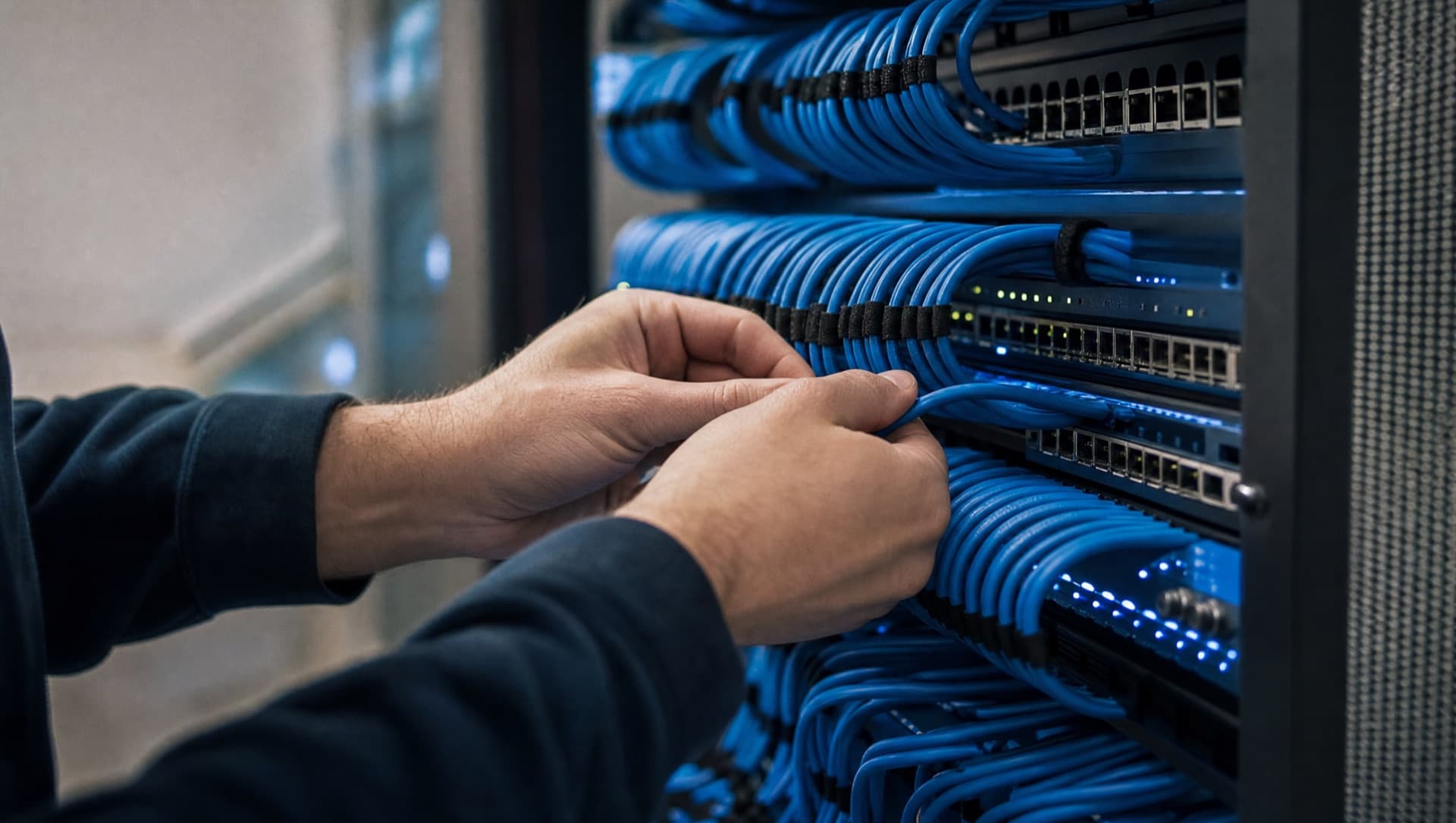
There are essentially two ways to connect several sites: a VPN that runs over each site's existing internet connection, or a leased line with a fixed, guaranteed bandwidth. For most businesses with two to five sites, a cleanly set up site-to-site VPN over solid business internet connections is entirely sufficient and considerably cheaper than a leased line. A leased line only becomes worthwhile once large volumes of data need to flow between sites continuously, or an outage of the connection simply isn't economically acceptable. The decision depends less on the number of sites than on what actually runs between them.
VPN or leased line: which connection fits the business?
A site-to-site VPN encrypts the connection between two sites over the ordinary internet – each site just needs a stable internet line and a firewall that reliably builds the VPN tunnel. Bandwidth is only as good as the underlying internet connection, and if the internet provider at one site goes down, so does the tunnel. A leased line, by contrast, is a dedicated connection with guaranteed bandwidth, independent of what other customers of the same provider are doing at the time. It costs more but delivers predictable latency – important for applications that depend on fast response times, such as terminal sessions on a central ERP server or telephony across several sites. For plain data exchange, email and access to central file storage, a VPN is generally enough.
- Site-to-site VPN for most cases: cheap, quick to set up, sufficient for email, file access and standard applications
- Leased line where consistently high, guaranteed bandwidth is needed, for example large data volumes from production
- Test latency-critical applications like telephony or terminal sessions first, before deciding on the type of connection
- The internet connection at each site is the foundation of the VPN – a weak line at one site slows down the whole connection
Central or local services: where should servers and software actually run?
The second fundamental decision is where the actual services sit. Central means: a server or cloud instance at one site or with a hosting provider, which every other site reaches over the connection. Local means: each site has its own systems that keep running even without a connection to the others. Both have their place, and in practice it's usually a mix. Systems that are essential for the ongoing operation at a given site – production control, a retail till system, or a time-tracking terminal – should be built to survive a short outage of the site connection, if necessary with local caching that syncs later. Systems where a brief outage is tolerable – central ERP, email, file storage – can safely sit centrally.
- Business-critical local processes (production, tills, access control) should survive a short WAN outage at that site
- Central systems such as ERP, email or file servers can depend on the site connection if a short outage is tolerable
- Never keep backups solely at the same site as the data itself – a second site or an external storage location is mandatory
- When choosing new software, clarify upfront whether it requires permanent central access or allows offline operation per site
What happens at a site if the connection to the others goes down?
This question should be answered for every site individually before it comes up in practice. A site with no connection to head office needs locally working internet, its own local DNS resolution and, depending on the business, locally cached data for the most important processes. Where an outage would be especially painful, a redundant connection is worth it: a second internet line from a different provider, or a mobile backup connection that takes over automatically if the main line fails. More important than the technology is practising it: a failover that has never been tested tends to work less often than expected when it actually matters.
A simple test tells you a lot: disconnect the main line at a site for an hour outside business hours and watch what actually still works. The gaps that show up are usually exactly the ones that cause the most trouble later during real operation.
A new site is added: what needs sorting out technically during an acquisition
During a takeover or acquisition, your own, organically grown infrastructure meets someone else's – with its own address space, its own devices and often its own IT history. The biggest mistake is simply hanging the new site off the existing network via VPN without first checking what's actually running there. IP address ranges can overlap, causing conflicts as soon as the two networks are connected. Devices and software at the new site may carry older, insecure configurations you don't want pulled into your own network unchecked. That's why the process should always start with an inventory, followed by clean network separation with clearly defined, controlled crossing points – and only once those crossing points are in place, a step-by-step integration rather than one big merge in a single move.
- Before connecting: check both networks' IP address ranges for overlaps
- Inventory devices and systems at the new site before they're connected to the existing network
- First connection via a controlled, restricted link rather than open full access
- Plan the integration step by step: email and central systems first, critical or unclear legacy systems last
How should addressing be structured across multiple sites?
One point that often gets too little attention when the first site connection is set up is a consistent addressing scheme. As a company grows organically, each site eventually ends up with its own network, often built to whatever scheme happened to be at hand at the time – with the result that address ranges overlap once the sites need to be connected, or that nobody can say offhand which address range belongs to which site and which function. A clearly structured scheme, where site and function can be read directly from the address, makes later troubleshooting, firewall rules and connecting further sites noticeably easier. Skip this step at two sites and you pay for it in rework by the time you reach the third or fourth – rework that a bit of upfront planning would have avoided entirely.
Connecting several sites, or integrating a newly acquired site, in Vienna, Lower Austria or Slovakia? We review the existing connection and design a link that holds up in daily use and in an outage.
Get in touchYou'd rather not work this out yourself? The solution page explains how we plan, build and then run it.
See network & switchingQuestions about your IT infrastructure?
Talk directly to our team — no obligation, no detours.